Sensing Science through Modeling Matter
Importance
Early learners have significant—and highly untapped—potential for understanding abstract concepts and reasoning in sophisticated ways. Research has shown that technology offers powerful support for conceptual science learning in the early grades.
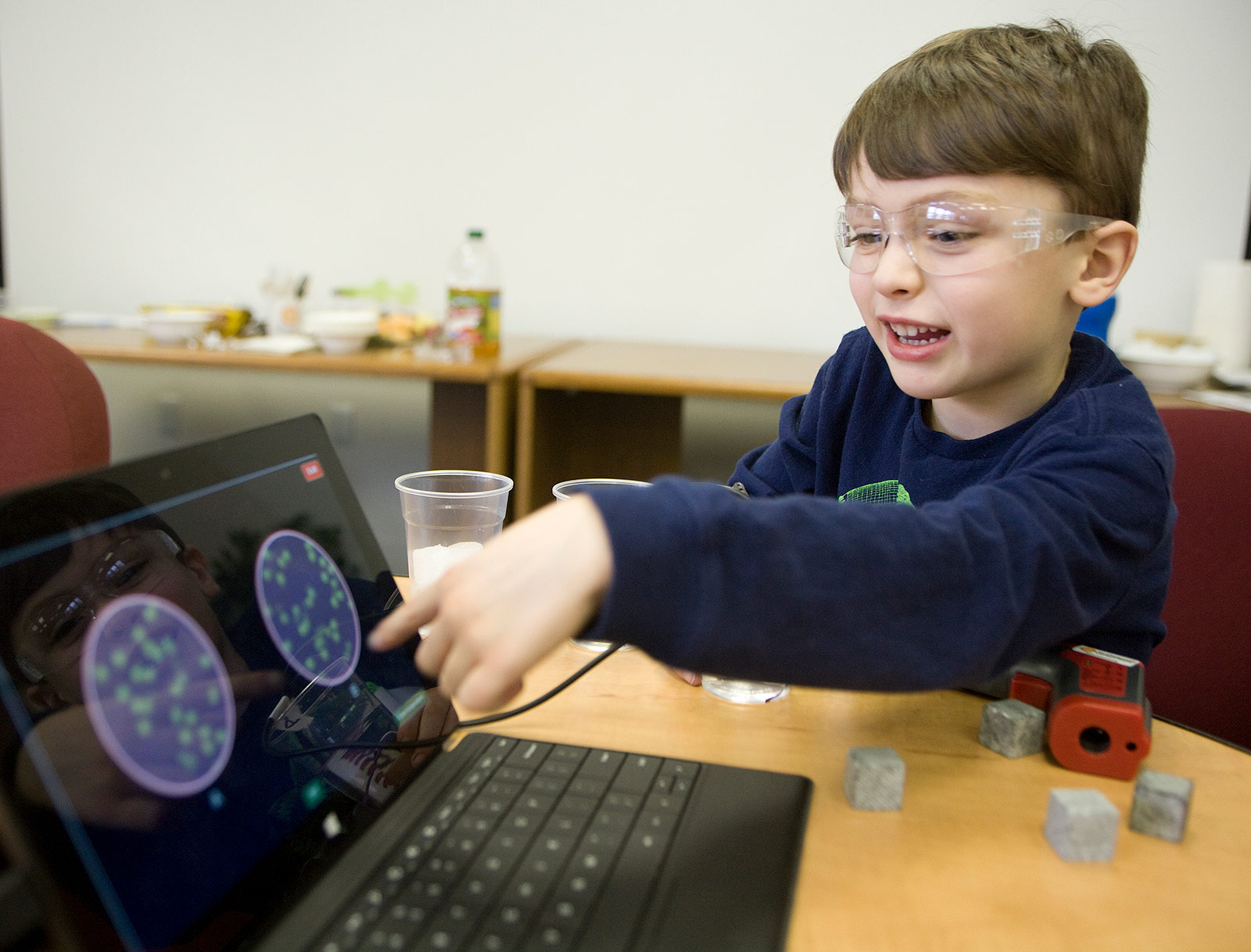
The Sensing Science through Modeling Matter: Kindergarten Students’ Development of Understanding of Matter and Its Changes project is developing and researching a technology-enriched curriculum to support learning about matter and its changes at the kindergarten level. We hope that creating a curiosity for science in the early grades is a strong foundation for later STEM learning.
With researchers from Purdue University and the University of Massachusetts, Amherst, we will develop and research a curriculum supporting early science learning of concepts involving matter and its changes. The curriculum will include dynamic technology-based visualizations and model-based inquiry and help demonstrate the possibilities opened up when opportunities to learn about fundamental science concepts are provided at an early age. The project will pilot this curriculum with over 300 students at four sites in Indiana and four sites in Massachusetts and investigate student learning.
Research
We’re investigating three principal research questions:
- How do kindergarteners understand and use particulate models to explain physical phenomena such as states of matter and phase changes?
- How does the modeling context influence kindergarteners’ ability to learn to model physical phenomena?
- How does maturation relate to kindergarteners’ ability to understand and use particulate models?
Publications
- Samarapungavan, A., Bryan, L. A., Staudt, C., Sapkota, B., Pinto, H. E. W., Broadhead, J. M., & Kimball, N. (2022). Using technology-mediated inquiry to help young learners reimagine the visible world through simple particle models. Journal of Research in Science Teaching.
- Staudt, C., Broadhead, J., Samarapungavan, A., & Bryan, L. A. (2022). Can elementary students reason about the invisible?. @Concord, 26(1), 12–13.
- Samarapungavan, A., Sapkota, B. K., Bryan, L. A., Staudt, C., Glidden, A., Broadhead, J., Pinto, H. E. W., & Hook, K. (2021). Developing kindergarten students’ conceptions of microscopic properties of matter through modeling-based, technology-enriched instructions. Paper presented at the 2021 Annual Meeting of the American Educational Research Association (AERA), Washington, DC.
- Kimball, N., Forman, G., & Staudt, C. (2019). Young children explore the particle world with apps. @Concord, 23(2), 10-11.
- Sarama, J., Clements, D., Nielsen, N., Blanton, M., Romance, N., Hoover, M., Staudt, C., Baroody, A., McWayne, C., & McCulloch, C. (2018). Considerations for stem education from pre-k through grade 3.
- Staudt, C., & Broadhead, J. (2017). Sensing science through modeling matter. @Concord, 21(1), 12-13.
- Kimball, N., & Broadhead, J. (2015). The land of bump. @Concord, 19(2), 10-11.
- Staudt, C., & Forman, G. (2014). Sensing science: Temperature and heat readiness for early elementary students. @Concord, 18(1), 10-11.
Notifications
Save